



Written by Greg Drecher, ISA Certified Arborist #PD-2775A, Executive Tree Care
It is one of the most common questions I get on a job site. A homeowner walks me out to their yard, points at a tree that is not looking right, and asks: How long does it have? More often than not, what they are describing are tree decline signs they noticed but did not know how to read.
Honestly, my answer is always the same: it depends. Not because I am dodging the question, but because tree decline does not follow a fixed schedule. I have seen trees that looked rough stabilize for years with the right care. I have also seen trees that looked fine from the street come down in the next storm. What determines how long a tree has is not age or size alone. It is what is actually happening inside that tree right now, and how fast those problems are progressing.
What I can do is show you what I look for when I walk a property. Because the signs are usually there. Most homeowners just do not know what they are looking at yet. Knowing the signs of tree decline before a failure happens can save you significantly more than the cost of a call.
Why There Is No Simple Answer
Tree decline is not a straight line. A tree can be in the early stages of decline for a decade before anything visible happens. Or it can go from stressed to failed in a single growing season if the right conditions line up.
Several factors determine how fast a tree declines once problems start:
Species matters more than most people realize. In DelCo and across the Main Line, we see a lot of oaks in various stages of decline. It is one of the most common things I assess. Ash trees are a different story. With emerald ash borer now established throughout southeastern Pennsylvania, most untreated ash trees in our area are already significantly compromised. White pines and silver maples present a different challenge. When they get large, they tend to become brittle. They do not compartmentalize wounds well, which means damage from storms, pruning cuts, or pest entry points does not heal the way a healthier species would.
Site conditions accelerate or slow everything. One of the first things I look for when I walk a property is the grade, meaning how the land sits around the tree’s root zone. Trees that have been sitting in standing water or poorly draining soil for years are often drowning slowly from the roots up. You would never know it from looking at the canopy in spring, but by midsummer that tree is struggling in ways that will eventually show.
History of damage and pruning leaves a record. A tree that was topped ten or fifteen years ago carries that damage forward. Bad cuts create entry points for decay and structurally weak regrowth. That history matters when I am trying to assess how much life a tree has left.
Common Tree Decline Signs I Look For on Every Site Visit
When a homeowner calls because they are worried about a tree, here is what I am reading when I walk up to it.
The canopy tells the story first
A healthy tree should have a full, even canopy spread. When I start seeing large areas of dieback, dead branches concentrated in the upper crown, or sections where the leaves just never came back, that tree is telling me something. As a general rule, if a tree has lost more than 30% of its canopy, meaning less than 70% of it is still leafed out and functioning, it is usually beyond the point where treatment makes sense. Removal becomes the more responsible conversation.
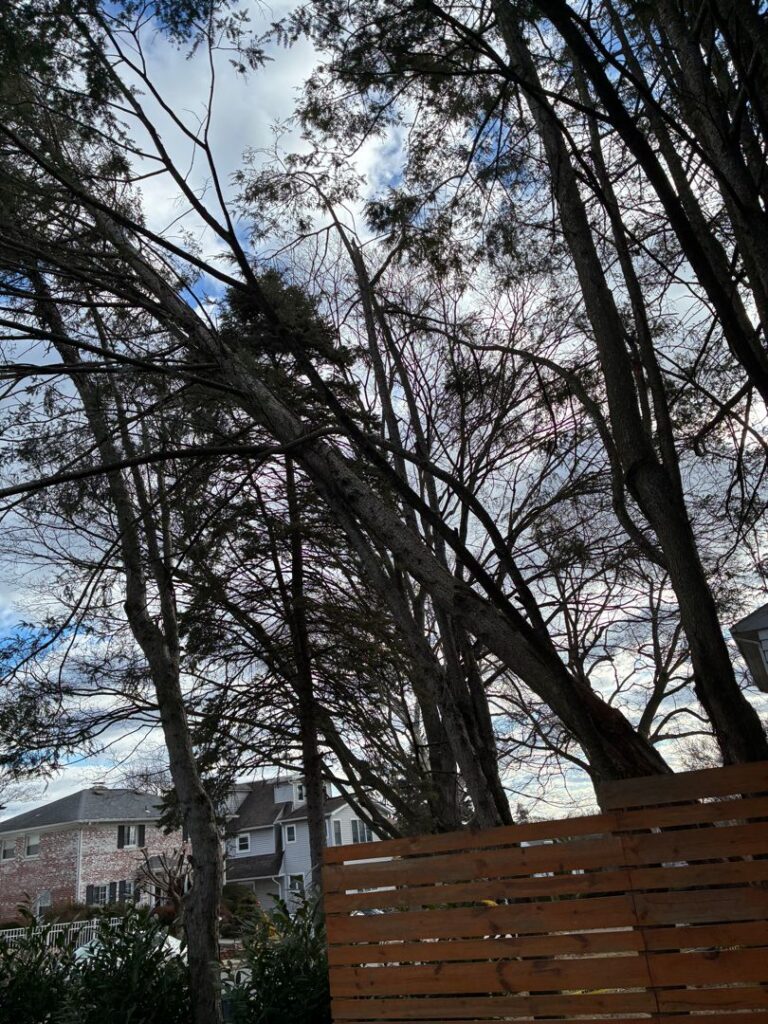
Tip dieback in the upper crown specifically is something I point out to homeowners. It usually means the tree is struggling to move water and nutrients to its outermost growth. That is a medium-term warning sign, not necessarily an emergency today, but a sign the tree is working hard and losing ground.
Fungus at the roots is a different conversation
When I see fungal growth at the base of a tree, shelf fungi, mushrooms coming up from the root flare, anything like that, that is a sign of internal decay that is already well established. A tree with significant root rot is not a “let’s monitor it” situation. I am telling that homeowner that the next significant storm is a real risk. I cannot give them a date, but I can tell them the structural integrity is already compromised.
Fractures and cankers along the trunk
Vertical cracks, areas where bark is missing or has separated from the wood beneath, cankers. These are signs of active structural problems. The ISA identifies cracks or splits in the trunk as one of the primary defects to look for when assessing tree risk. When I see fractures anywhere along the main trunk, especially combined with other decline indicators, I am telling the homeowner it is just a matter of time.
Co-dominant stems are a structural problem you can see
This is one of the things I wish more homeowners knew to look for before calling us. A co-dominant stem is when a tree grows two or more trunks of roughly equal size from the same point, forming a tight V-shaped union. That V is the problem. Over time, bark gets trapped between the two stems, what arborists call included bark, and it prevents the wood from fusing the way it should. The result is a weak point that can split under load, often with very little warning.
Trees and utility lines
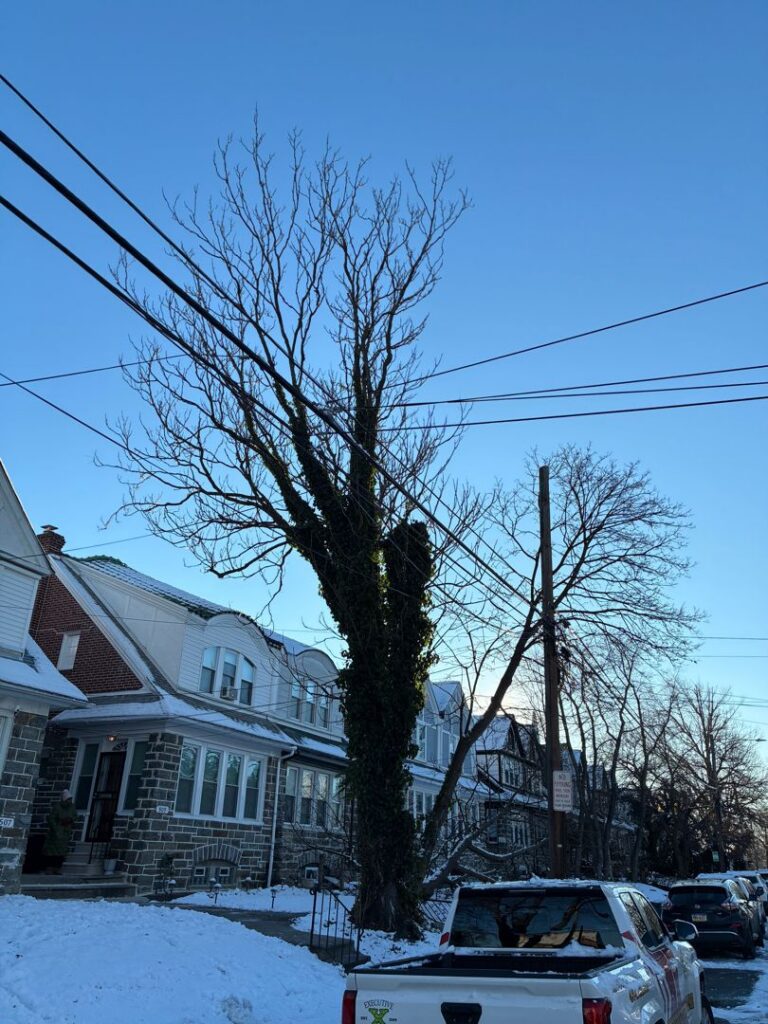
Any tree showing signs of decline near utility lines, including communication lines like cable and telephone, moves up in priority. The ISA specifically identifies trees near utility lines as a serious hazard category. A failing branch or trunk over a utility line creates risk not just for the property but for the surrounding area. If you have a declining tree near any overhead line, that is not a situation to monitor from a distance.
Heavy ivy is a warning sign, not just a visual problem
If you have a mature tree with ivy growing heavily up the trunk, that ivy is doing more than covering the bark. It adds weight, retains moisture against the bark, and masks whatever is happening underneath. When I cannot read the bark on a tree, I cannot assess it properly. Ivy at that scale on a large tree is always worth a closer look.
Proximity to targets
One thing I always factor in is what the tree is near. A declining tree in an open field is a very different situation from a declining tree hanging over a house, a parked car, a shed, or a play area. Any tree with large limbs over 2 inches in diameter showing signs of underlying stress over a high-value target needs attention sooner rather than later.
A Basic Self-Assessment Before You Call
You do not need an arborist certification to do a basic read of a tree on your property. The International Society of Arboriculture publishes a Tree Risk Checklist that homeowners can use as a starting point. Here are the key questions to ask when you walk your yard, drawn from that checklist and from what I look for on every site visit:
- Are there large dead branches in the canopy?
- Are there detached or hanging branches?
- Have any branches already fallen from the tree?
- Is there loose bark on the trunk?
- Are there cracks or splits in the trunk or where major branches are attached?
- Has the trunk developed an unusual lean or shape?
- Are there cavities or areas of rotten wood along the trunk or in major branches?
- Are mushrooms present at the base of the tree or under the canopy?
- Has the area around the tree been altered recently by construction, new pavement, or changes in soil level?
- Has the tree been topped or heavily pruned in the past?
- What is the tree near? House, car, shed, play area, utility lines.
If you answered yes to any of these questions, it is worth a professional assessment. If you answered yes to more than one, do not wait. The full ISA checklist and additional resources are available at TreesAreGood.org.
This checklist is a starting point, not a substitute for a professional evaluation. The ISA’s Tree Risk Assessment Qualification (TRAQ) is the professional standard for formal tree risk assessment. What I am describing here is a homeowner-level read designed to help you know when a call makes sense.
When Waiting Costs More Than Acting
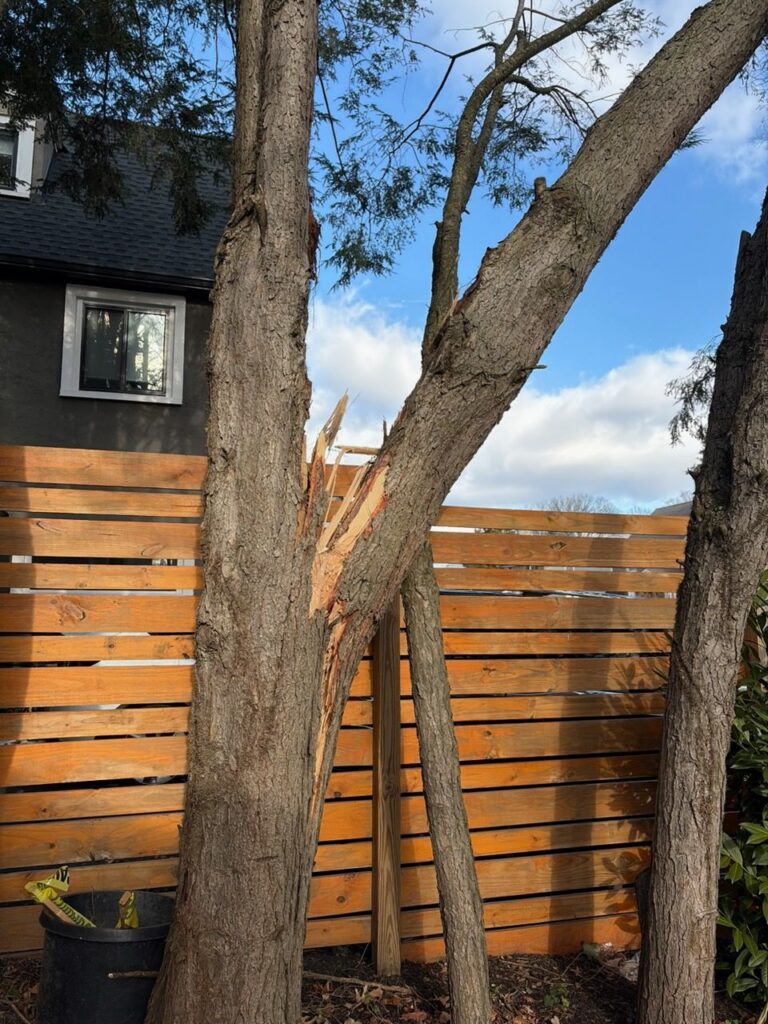
Structural damage to the trunk of a 16-inch hemlock in Wynnewood, PA following wind failure.
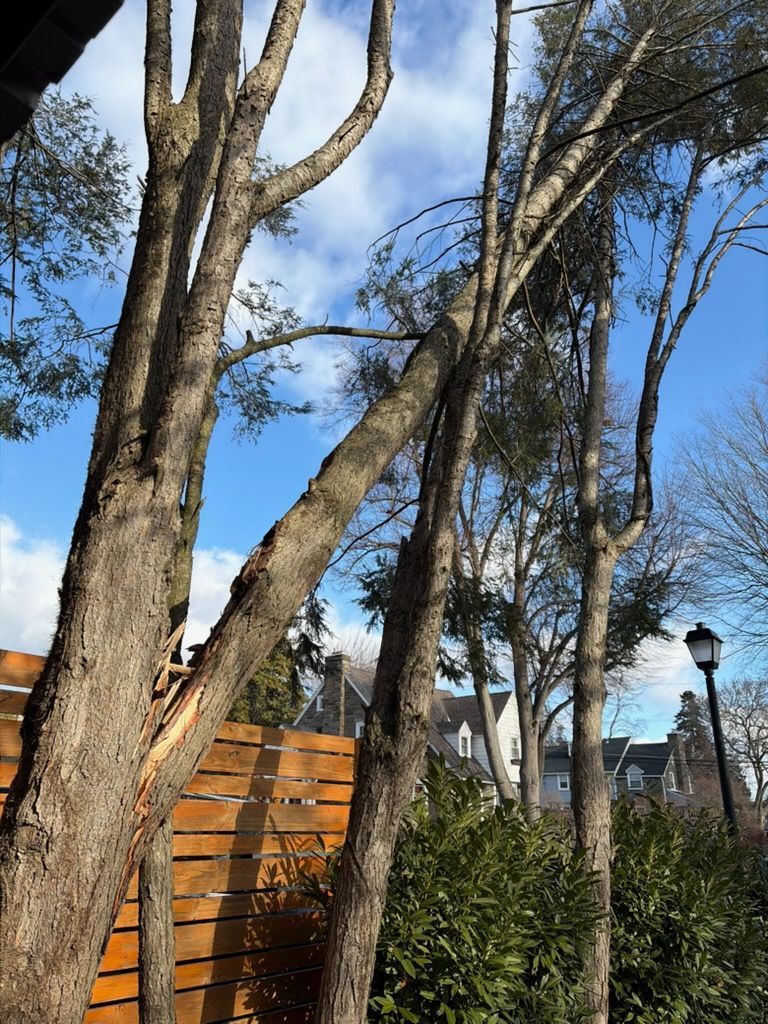
The most common thing I see is homeowners who knew something was off for a year or two before calling. They were hoping it would stabilize. Sometimes it does. More often, the condition progresses to the point where a tree that could have been removed cleanly on a scheduled basis becomes an emergency removal after a failure. Emergency removals cost significantly more, sometimes with property damage attached.
The hemlock photos above are from a Wynnewood job where wind brought down a 16-inch tree that had been showing significant crown dieback. By the time it came down, it was an expedited emergency call. Trees in that condition do not give much warning when the right storm comes through.
If you have a tree on your property and something looks off, call and get eyes on it. A free assessment does not commit you to anything, and the information is useful regardless of what you decide.
For more on identifying tree risk before a storm, read Is That Tree in Your Yard a Risk? What to Look For This Spring.
After a storm has already caused damage, read After the Storm: What Delaware County Homeowners Should Do About Damaged Trees.