



Published by: Executive Tree Care Team
Author byline: Written by Doug Bull, ISA Certified Arborist #PD-0544A, and Greg Drecher, ISA Certified Arborist #PD-2775A — Executive Tree Care
Date: March 2026
Most homeowners think about their trees when something goes wrong. A branch comes down in a storm. A neighbor’s tree falls on a fence. That’s a natural reaction, but by the time a tree fails, the warning signs were usually there months or even years earlier.
Spring is the right time to look. Winter in the Philadelphia region puts real stress on trees. The freeze-thaw cycles that run through January and February in Delaware County and across the Main Line work on old wounds, expand cracks, and destabilize root systems that were already compromised. Before the canopy fills in and makes a thorough inspection difficult, there is a window right now to walk your property and look at what winter left behind.
This article explains what to look for, what it means, and when to call a professional.
What Is Tree Risk, and Why Does It Matter?
Tree risk is the combination of two things: the likelihood that a tree or one of its parts will fail, and the consequences if it does. A dead tree standing in an open field carries low risk. The same tree hanging over a bedroom roof is a different situation entirely.
The International Society of Arboriculture defines tree risk assessment as a systematic process for identifying defects, evaluating their significance, and recommending action. ISA Certified Arborists are trained specifically in this process. It is not the same as a general walk-around or a “quick look” from the street.
For homeowners in Haverford, Bryn Mawr, Radnor, and the surrounding communities, tree risk is especially relevant. The Main Line is dense with mature trees: large oaks, silver maples, Norway maples, and American elms that have been growing for decades alongside homes, driveways, and utility lines. These trees provide enormous value. They also carry more consequence if they fail.
The Warning Signs You Can See From the Ground
You do not need to be an arborist to notice that something looks wrong. These are the signs worth paying attention to.
Dead Branches in the Upper Canopy
Dead wood does not fall on a schedule. A large dead limb over a roofline can hold for years and then come down on a calm day with no warning. Look up at the crown of your trees and note branches that have no buds breaking as spring arrives, bark that is peeling or missing, or wood that looks gray and dry compared to the living branches around it. A cluster of dead branches is not normal aging. It is a sign the tree is under significant stress.
Cracks and Splits in the Trunk or Main Limbs
Not all cracks are the same. A shallow surface crack is different from a deep split that runs through the wood. What arborists are concerned about are cracks that penetrate the structural core of the trunk or a major limb, and cracks that appear at the junction where two large limbs meet. These co-dominant stems, as they are called, are one of the most common failure points on large trees in the Delaware County area. When two trunks of similar size grow together without a strong attachment, the pressure of their own weight over decades can eventually cause one to split away from the other. The split often happens under wind load or ice weight.
Leaning That Was Not There Before
A gradual lean that a tree has held for years is usually not urgent. A lean that has changed recently is a different matter. If the soil around the base of the tree looks heaved or cracked on one side, or if you notice the tree has shifted position compared to how it stood last fall, the root system may be failing. This is a scenario that warrants an immediate professional evaluation.
Decay at the Base or Along the Trunk
Soft wood, hollow areas, fungal growth, and carpenter ant activity at the base of a tree are all indicators of internal decay. Fungi like shelf mushrooms growing on the trunk are a sign that decay is already established inside the wood. The tree may still look healthy from a distance, still leafing out in spring, still standing straight. But structurally, the interior may be significantly compromised. This is one of the reasons visual inspection from the yard is not always sufficient for large trees.
Root Damage You May Not Have Considered
Roots extend far beyond the visible trunk, typically two to three times the height of the tree in radius. Anything that damages that root zone, including trenching for utilities, new construction, compacted soil from vehicles, or grade changes, can destabilize a tree silently over several years. If work has been done near a mature tree in the past five years, that tree should be evaluated regardless of whether it currently shows visible symptoms.
Trees That Look Fine Can Still Fail
This is the part most homeowners do not expect to hear: the tree that comes down is often not the one that looked obviously sick. Internal decay is invisible from the outside until it is advanced. A root system compromised by construction damage may not show symptoms in the canopy for three to five years. A co-dominant stem may hold for decades and then fail in a single storm.
Doug Bull, one of our ISA Certified Arborists, describes a job in Wallingford that illustrates this exactly. A red oak near a historic building adjacent to the middle school came down without warning. The property owners had never engaged an arborist for pruning or inspections. When the tree was examined, it had Armillaria root rot, a fungal disease that attacks the root system at its base and is, in Doug’s words, “extremely easy to identify” by a trained arborist. The disease causes profound structural root loss, meaning the tree loses its anchor long before the canopy shows obvious decline. From the street it looked like a tree. From the ground after it fell, the root system told a different story entirely.
That is not an unusual situation. It is a common one.
This is why ISA Certified Arborists do not simply look at a tree and give it a pass. A proper risk assessment includes evaluating the structural architecture of the tree, the soil conditions around it, the health of the root zone, and what is in the tree’s target zone if it were to fail. That last part matters. A tree leaning away from structures with nothing in its path has a very different risk profile than the same tree positioned over a roof.
What Happens When a Tree Actually Falls
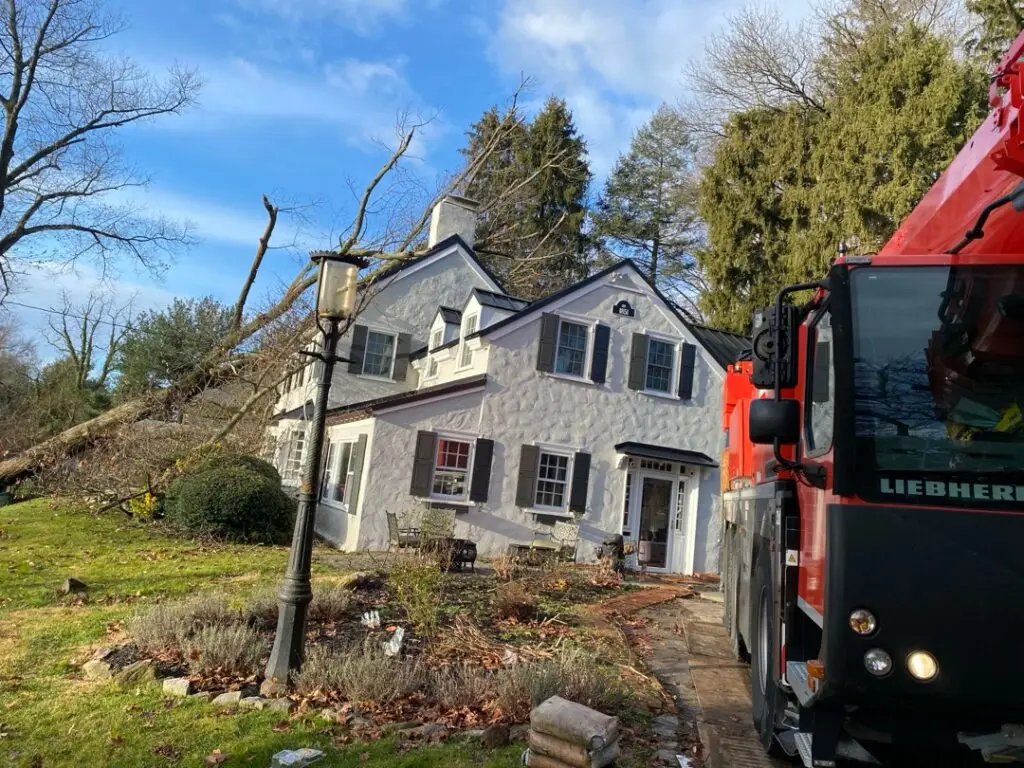
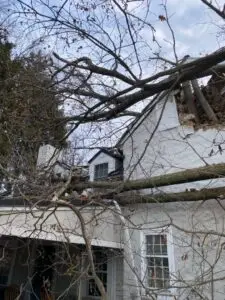
The photo at the top of this article is a real job. A crane is required when a tree has come down on a structure because the wood is under tension in ways that make chainsaw work from the ground dangerous. The roof damage, the structural repair, the crane cost, the debris removal: it adds up quickly. In most cases on the Main Line, the homeowner’s insurance will cover the structure repair if the tree fell due to a storm, but the tree removal itself is often the homeowner’s expense. Prevention is consistently less expensive than emergency response.
Emergency tree service calls also come at a premium. Availability after a significant storm is limited. Crews are dispatched to the most critical situations first. Scheduling a proactive assessment in March, before spring storm season begins, is a practical decision.
What a Professional Assessment Actually Involves
When an ISA Certified Arborist evaluates a tree, they are working through a structured process. They examine the crown for dead wood and structural defects. They assess the trunk for cracks, cavities, and decay indicators. They evaluate the root zone and the soil. They consider the target: what is in the path if this tree or a part of it fails?
From that assessment, they can tell you whether the tree needs pruning to remove hazardous deadwood, whether structural cabling would help stabilize a co-dominant stem, whether the tree is in decline and removal should be scheduled, or whether the tree is healthy and simply worth monitoring.
Not every assessment ends in a recommendation to remove. Many do not. The goal is to give you accurate information so you can make a decision with full context.
Spring Is the Right Time to Look
March and April are the best months for a tree risk assessment in our service area. Here is why. The canopy has not yet fully leafed out, which means the branch structure is visible in a way it will not be in July. Any damage from the winter is fresh and easier to identify. And scheduling is more flexible before the spring rush, when emergency calls from storm damage start filling the calendar.
In 15 plus years serving Delaware County and the Main Line, the team at Executive Tree Care has seen what preventable failures look like. The trees that were assessed, pruned, or removed proactively are not the ones that make emergency calls. The ones that do are the trees that were noticed but not acted on.
Not Sure, That Is Reason Enough to Call
Homeowners often describe a tree they have been watching for a while, noting something feels off but not being sure if it warrants a call. That uncertainty is worth resolving. An assessment does not commit you to any work. It gives you information.
If you have mature trees on your property in Haverford, Wayne, Springfield, Newtown Square, West Chester, Media, or anywhere across the Main Line and Delaware County, now is the time to look.
Ready to have an ISA Certified Arborist assess your trees before spring storm season?
Schedule your free estimate today.
Executive Tree Care has served Delaware County and the Main Line since 2009. Our ISA Certified Arborists provide tree risk assessments, pruning, removal, and emergency services for residential and commercial properties. We are fully licensed and insured.
For emergency service, call (484) 451-8900 — available 24 hours.