



Published by: Executive Tree Care Team Author byline: Written by Doug Bull, ISA Certified Arborist #PD-0544A — Executive Tree Care Date: March 2026
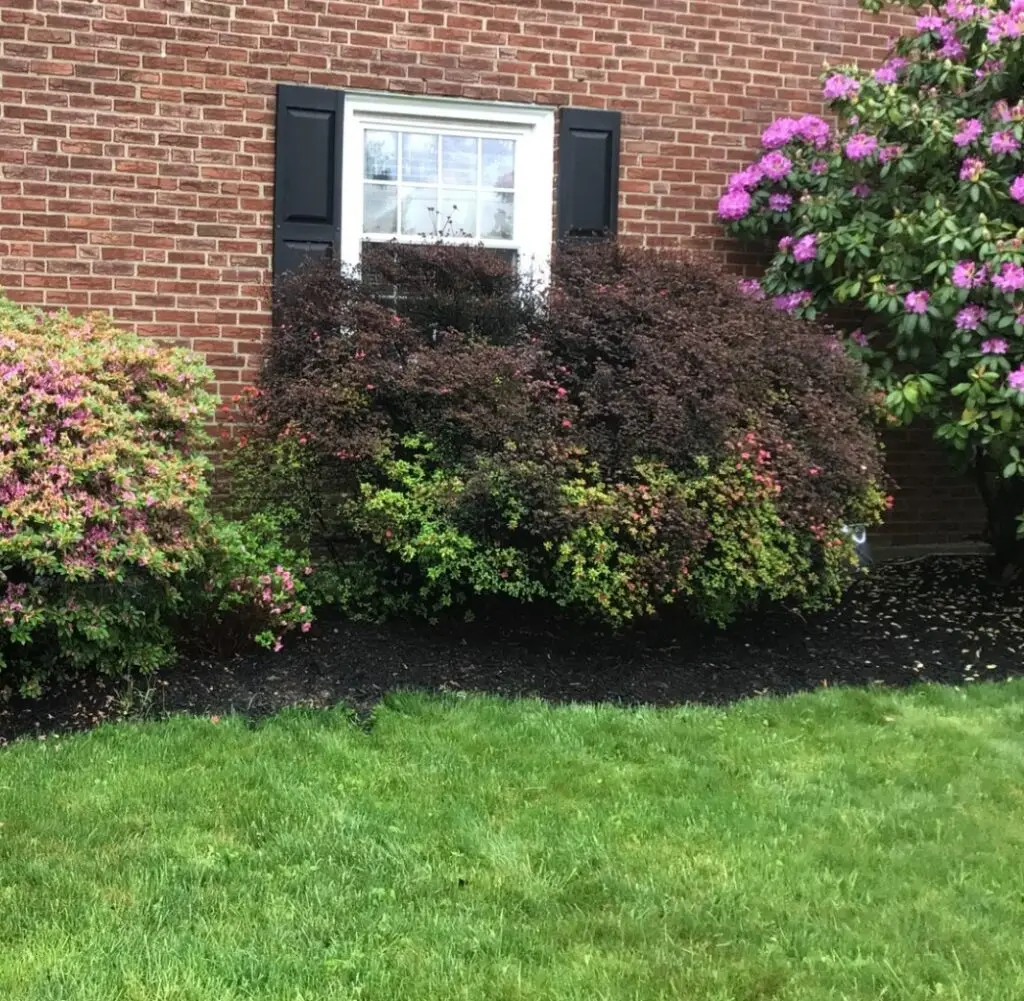
Walk any neighborhood in Haverford, Bryn Mawr, or Newtown Square right now and you will see the same thing: yards waking up from winter, and a lot of deferred maintenance waiting to be dealt with. Overgrown shrubs. Trees pushing new growth through old deadwood. Grass competing hard with everything around it for the same soil, the same water, the same space.
As Doug Bull, ISA Certified Arborist with Executive Tree Care, puts it: “Deferred maintenance with landscape diseases never ends well. Spring cleanups can reduce maintenance over the summer when people are living their best life.”
That is the practical case for getting ahead of it now. But there is a broader point that most homeowners miss, and it is one that shapes how we approach spring care at Executive Tree Care: your trees, shrubs, lawn, and garden do not operate independently. They share the same soil. They compete for the same resources. What happens to one affects the others. That is why the right approach in spring is not just tree trimming or just lawn care. It is Plant Health Care.
What Is Plant Health Care?
Plant Health Care, or PHC, is a term from the International Society of Arboriculture that describes something straightforward: managing the health of your entire landscape, not just individual plants, through regular monitoring and preventive treatment.
Most property owners think about their trees when something is obviously wrong. A tree is leaning. Branches came down over the winter. The shrubs along the front walk look ragged. By the time those problems are visible, they have usually been developing for a season or more. PHC flips that approach. Instead of reacting to problems, an arborist monitors your landscape on a schedule, catches issues early, and addresses them before they become expensive or irreversible.
The ISA describes the objective of PHC simply: to maintain or improve the appearance, vitality, and safety of your landscape using the most effective and environmentally responsible treatments available.
That includes pruning. It includes targeted treatments for disease and pests. It includes soil management, fertilization, and monitoring for problems that are not yet visible from the street. And critically, it includes understanding how everything in your landscape is interacting with everything else.
Why Trees and Your Lawn Are Not on the Same Team
Here is something that surprises a lot of homeowners in Delaware County and along the Main Line: your lawn and your trees are in direct competition, and your lawn is often winning in ways that hurt your trees.
Turfgrasses and tree roots occupy the same zone in the soil, roughly the top six inches. Grass roots are aggressive. In areas where trees established first, grass root density is lower because the tree got there first. But in most suburban landscapes, the lawn was planted around existing trees, and the grass competes hard for water and nutrients that the tree also needs.
This shows up in predictable ways. Thinning grass under large shade trees is one sign. Young trees that do not seem to grow despite regular watering are another: the turf around them is out-competing them for resources before they can establish. Large surface roots that make mowing difficult are a symptom of a tree pushing its roots up toward the surface in search of water and oxygen that compacted soil below is not providing.
The conflict runs the other direction too. Herbicides applied to lawn can cause serious damage to tree roots when misapplied or when they drift on windy days. Fertilizer absorbed by one plant is also absorbed by its neighbors. Frequent shallow lawn watering does not meet the needs of trees, which generally require the equivalent of one inch of rain every seven to ten days. The short shallow cycles that keep grass green can actually work against the deeper root development trees need.
None of this means you cannot have a healthy lawn and healthy trees. It means they require coordinated management, not two separate approaches that ignore each other.
What Spring PHC Actually Looks Like
Right now, in late March, the work Executive Tree Care is doing in Delaware County and along the Main Line falls into two main categories: trimming and PHC treatments for spring. That is not a coincidence. They go together for a reason.
Trimming in early spring, before full leaf-out, accomplishes more than it does in summer. The branch structure is visible. Any deadwood from winter is identifiable. Crossed or rubbing branches can be addressed before they create wounds that invite disease during the growing season. Overgrown shrubs that have been allowed to grow without shaping compete more aggressively with surrounding plants and often develop interior dieback that is harder to recover from the longer it is left.
PHC treatments in spring are timed to when they are most effective. Soil conditions coming out of winter, the early emergence of insects and fungal pathogens, and the stress trees and shrubs carry from freeze-thaw cycles all make spring the window when targeted treatments have the most impact. Waiting until a problem is visible in summer often means waiting until the damage is already done.
What a PHC program covers depends on your specific landscape. At a minimum it involves:
- A monitoring visit to assess current tree and shrub condition
- Identification of any pest, disease, or structural issues
- A treatment plan matched to what is actually present, not a generic spray schedule
- Coordination with your other landscape maintenance so treatments do not work against each other
- Specialized soil treatments your arborist may recommend based on what the assessment finds
The size and longevity of trees and shrubs warrant special attention that annual plants do not. A tree that takes fifteen years to reach maturity is not something you replace in a season. Early intervention is the only way to protect that investment.
The Mulch Question Most Homeowners Get Wrong
One of the most effective things a homeowner can do to support tree health in spring costs very little and is almost universally done incorrectly.
Mulching around trees is the best alternative to turf in the root zone. A two to four inch layer of wood chips or bark over the area beneath the tree’s canopy retains soil moisture, reduces weed and grass competition, improves soil biology as it breaks down, and protects the trunk from the one thing that damages more trees in suburban Delaware County than any disease: the lawn mower and string trimmer.
Equipment contact with tree trunks causes wounds that become entry points for decay. It is slow damage that accumulates over years and is completely preventable.
The mistake most people make is the mulch volcano: piling mulch up against the trunk itself, sometimes eight or ten inches deep. That keeps moisture against the bark, encourages disease, and over time can girdle the tree. The correct approach is a flat layer that stops a few inches away from the trunk and extends out to the drip line where the canopy ends.
What to Watch For Right Now
If you have mature trees on your property, spring is the time to look at them before the canopy fills in and makes a thorough assessment difficult. A few things worth noting as you walk your property:
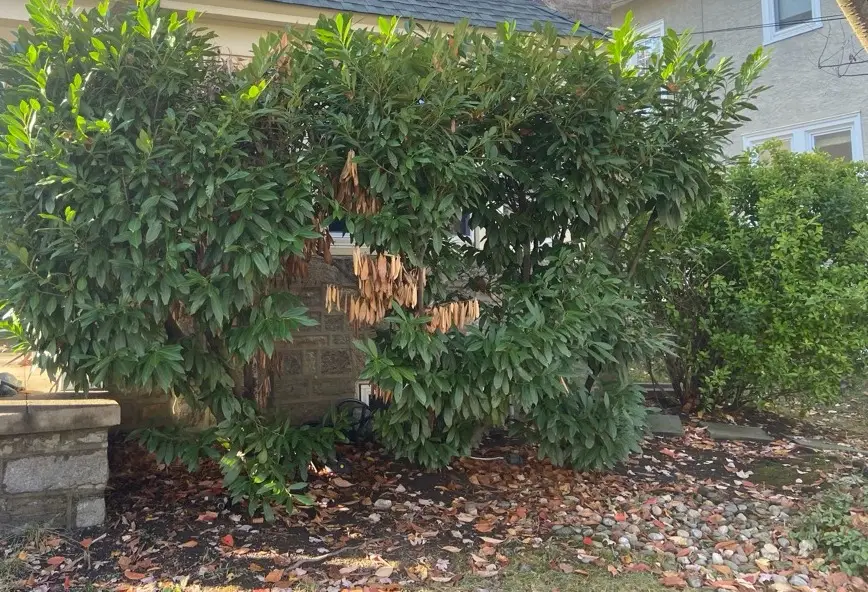
Shrubs that have not bounced back from winter. Some winter dieback is normal. Widespread dieback across multiple plants, or shrubs that show no new growth as the season advances, can indicate a disease or pest issue that will spread if left unaddressed.
Grass thinning under large trees. This is not a lawn problem. It is a competition and soil compaction problem that a PHC approach addresses from the tree side, not just by overseeding.
New construction or grade changes near existing trees. Soil disturbance in the root zone, even work done two or three years ago, can show up as canopy decline now. If work was done near a mature tree and the tree seems less vigorous than it used to be, that connection is worth exploring.
Trees that feel like they have been on your radar. Homeowners often describe a tree they have been watching for a while, not sure if it warrants a call. That uncertainty is reason enough to have someone look at it. An assessment does not commit you to any work. It gives you information before a problem becomes a crisis.
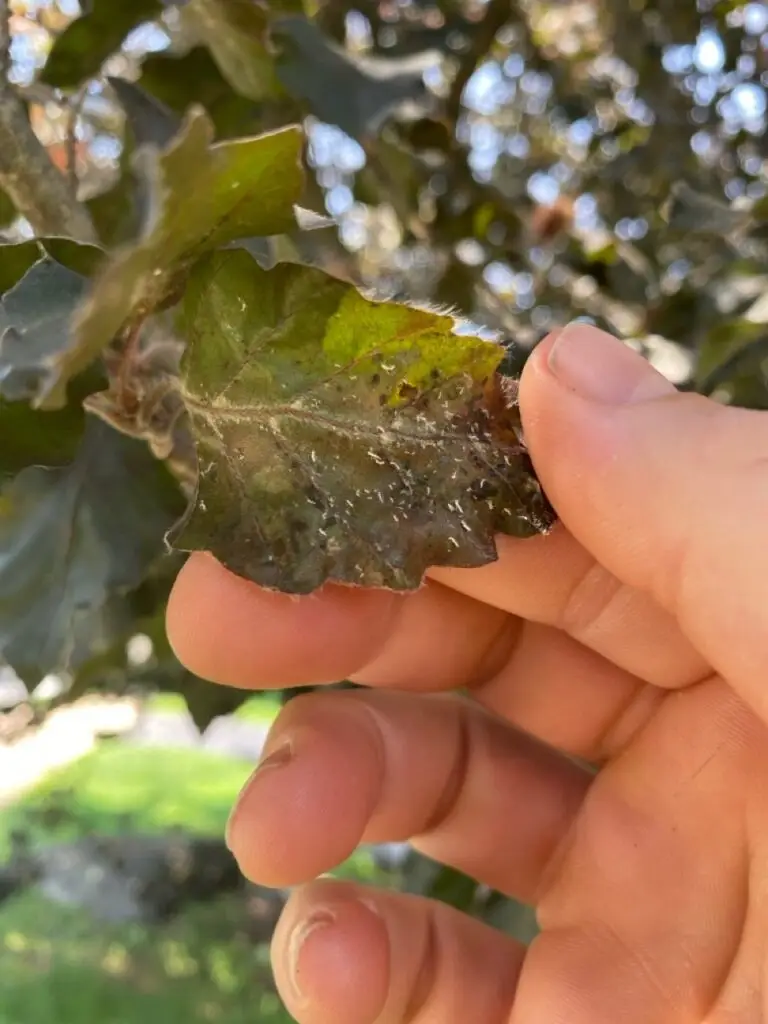
Pest pressure you cannot see without looking. Scale insects and aphids are among the most common early spring problems on shrubs in Delaware County and the Main Line, and they are almost invisible until an infestation is well established. White prunicola scale on laurel, scale on holly, and aphid activity on oak are problems ETC is treating right now. The damage shows up later as yellowing, dieback, and declining vigor — by which point the pest has had a full season to spread.
Why Spring Is the Right Time to Start
Doug’s point about summer is worth coming back to. The goal of spring PHC is not just to fix what winter did. It is to set your landscape up so that by June and July, when you want to be outside enjoying your property, you are not dealing with a shrub disease that spread unchecked, a tree that needs emergency attention, or a lawn and tree competition problem that got worse through another season of neglect.
In more than 15 years serving Delaware County and the Main Line, the team at Executive Tree Care has seen what that looks like from both directions. The properties that get spring attention consistently look better, have fewer emergency calls, and protect the value of the trees and shrubs that took decades to grow.
The ones that defer it tend to defer it again. And as Doug said, that never ends well.
Ready to have an ISA Certified Arborist assess your trees and shrubs this spring? Schedule your free estimate today.
Executive Tree Care has served Delaware County and the Main Line since 2009. Our ISA Certified Arborists provide plant health care programs, tree and shrub trimming, tree removal, and emergency services for residential and commercial properties. We are fully licensed and insured.
For emergency service, call (484) 451-8900 — available 24 hours.