



Written by Greg Drecher, ISA Certified Arborist #PD-2775A
Executive Tree Care — Serving Delaware County, Montgomery County, and Chester County since 2009
Every spring, we get calls from homeowners we worked with the previous season. The tree is gone, the hazard is resolved, but something feels off. The afternoon shade has shifted. The privacy along the back fence is not what it used to be. The view from the deck looks different, and for many homeowners across Delaware County, tree planting becomes the next conversation.
That is one of the less-discussed realities of tree removal. When a mature tree comes down, it does not just leave a stump. It leaves a gap in your canopy — sometimes a significant one — that changes how your property looks, feels, and functions through every season.
This article is for those homeowners — and for anyone across Delaware County, Montgomery County, and Chester County thinking about tree planting after a removal. It is also, honestly, for the clients who have told us on follow-up calls that they do not need us anymore because we already removed everything. We understand that reaction. But tree removal is not the end of your tree story. For many properties across Delaware County, Montgomery County, and Chester County, it is the beginning of a better one.
What Trees Actually Do for Your Property
Before talking about replacement, it helps to understand what you are replacing. Trees are not decorative. They do real work on your property every single day.
Shade and energy costs. A mature deciduous tree on the south or west side of your home can meaningfully reduce summer cooling costs by blocking direct sun from your windows and roof. In winter, that same tree drops its leaves and lets sunlight through — a seasonal rhythm that helps passively warm the home. The Department of Energy has documented that strategically placed trees can reduce heating and cooling costs in ways that compound as the tree matures over time.
Privacy. Evergreen species hold their foliage year-round and can create a natural screen between your property and a road, a neighbor, or a commercial area. On many older Main Line properties in Bryn Mawr, Wayne, and Haverford where tree lines are thinning, a well-placed planting makes a noticeable difference within just a few growing seasons.
Home value. Mature trees add measurable resale value. Most homeowners in this area already sense this intuitively — properties with established canopy look and feel different from ones without it. Young trees planted thoughtfully today become that asset in ten to fifteen years.
Temperature regulation. Windbreak plantings — typically evergreens on the north and northwest sides of a property — reduce heat loss in winter. Combined with shade plantings on the south and west, a well-planned canopy functions as insulation that grows in value every year.
Tree Planting in Radnor: What We Did in 2025
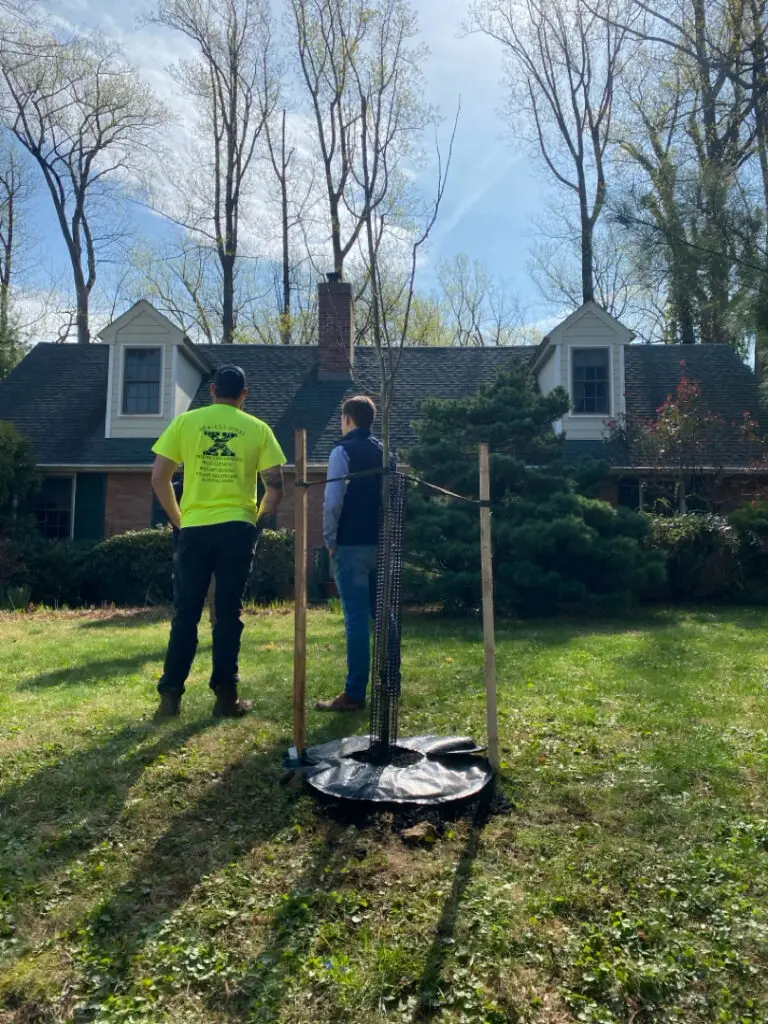
In spring 2025, Executive Tree Care partnered with the Pennsylvania Horticultural Society’s Tree Tenders program in Radnor, providing planting services at no cost to residents as part of the community canopy initiative. PHS is a nonprofit founded in 1827 that works with community groups each spring and fall to plant trees at little or no cost to local residents across Bucks, Chester, Delaware, and Montgomery Counties. Residents sign up through the program and select their species from an available list — the planting and installation is then handled by volunteers and local partners like our crew.
The variety of species planted across Radnor is a useful illustration of the different functions trees serve and the site considerations that come with each choice. In these jobs, the species selection belonged to the homeowner. Our role was to make sure each tree went in correctly — right depth, proper staking, adequate mulch ring — regardless of what was chosen.
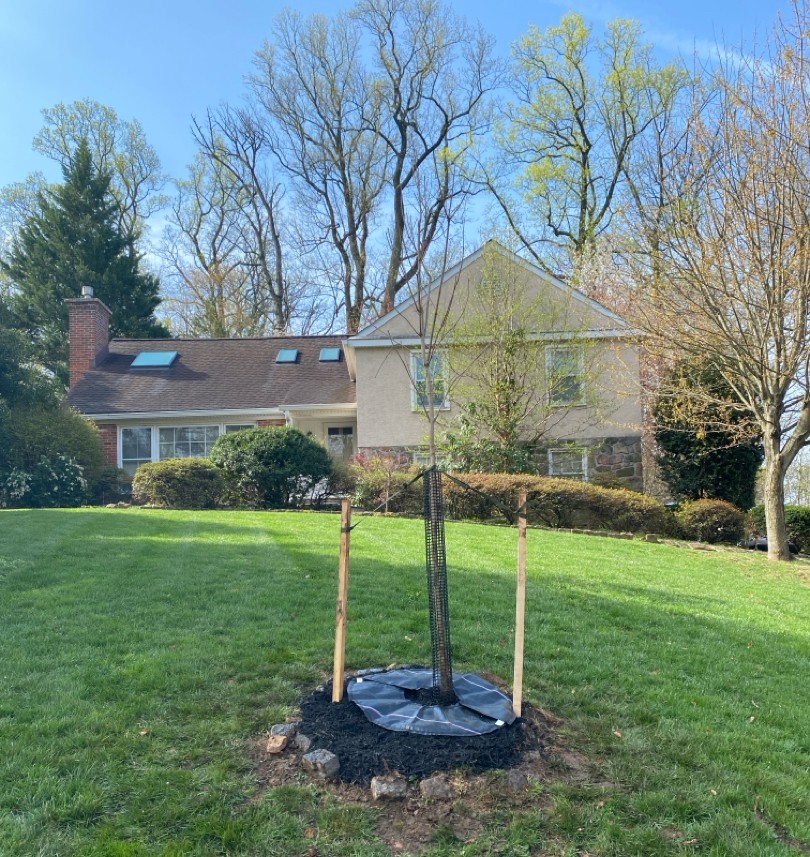
One of the plantings was the Black Maple ‘Greencolumn’ (Acer nigrum) — a cultivar that reaches 50 to 65 feet at maturity. It is a clean tree with no significant litter, a strong upright form, and it provides dense shade as it matures. The roadside location in the photo above also illustrates something worth considering at the time of species selection: overhead utility lines. A tree that reaches 50-plus feet planted directly below wires will require repeated clearance pruning as it matures. That pruning is manageable, but it is a cost and maintenance commitment worth knowing about from the start.
Common Tree Choices for Delaware County Properties
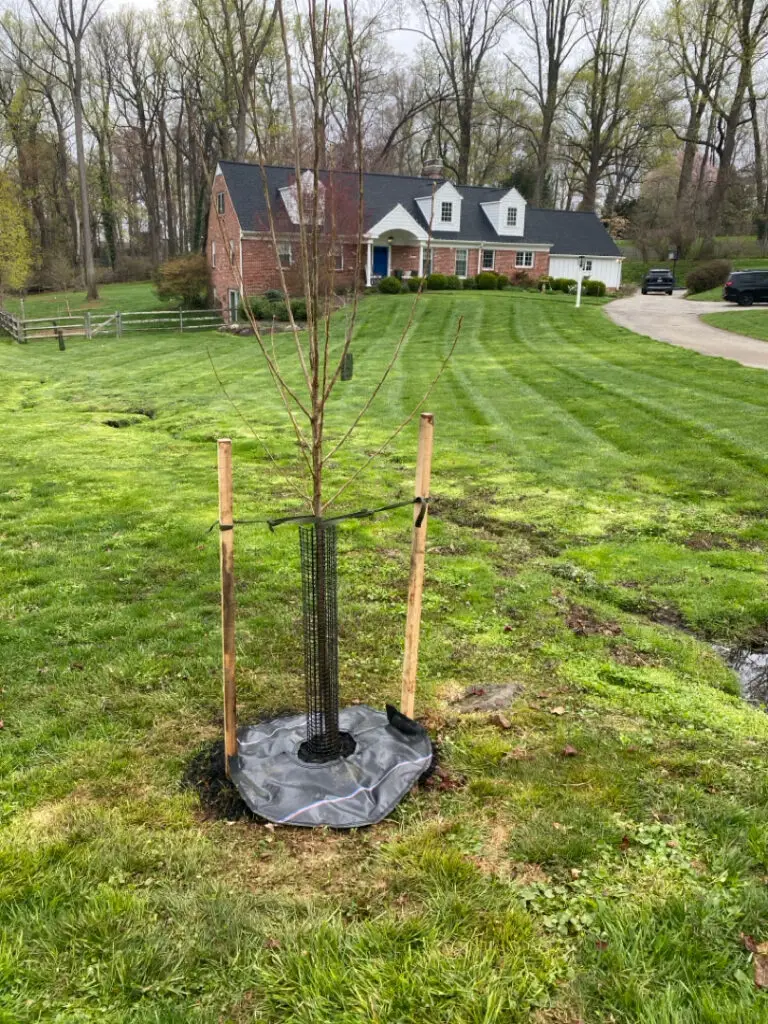
The Cottonwood Siouxland (Populus deltoides) is a fast-growing seedless cultivar that can reach 75 feet at maturity. The seedless designation eliminates the cotton the species is known for, which is a real maintenance advantage. The key consideration here is space — a 75-foot tree needs room to grow without crowding structures, utilities, or neighboring trees. The open lawn setting in this Radnor property gave it that room.
Choosing the Right Species for Your Site

The Osage Orange ‘White Shield’ (Maclura pomifera) is a fruitless cultivar that tops out around 35 feet. The fruitless designation matters here too — the standard species produces large, heavy fruit that creates a significant cleanup burden each fall. ‘White Shield’ eliminates that entirely. It is drought-tolerant and relatively low maintenance once established, which makes it a practical choice for a mixed planting bed.
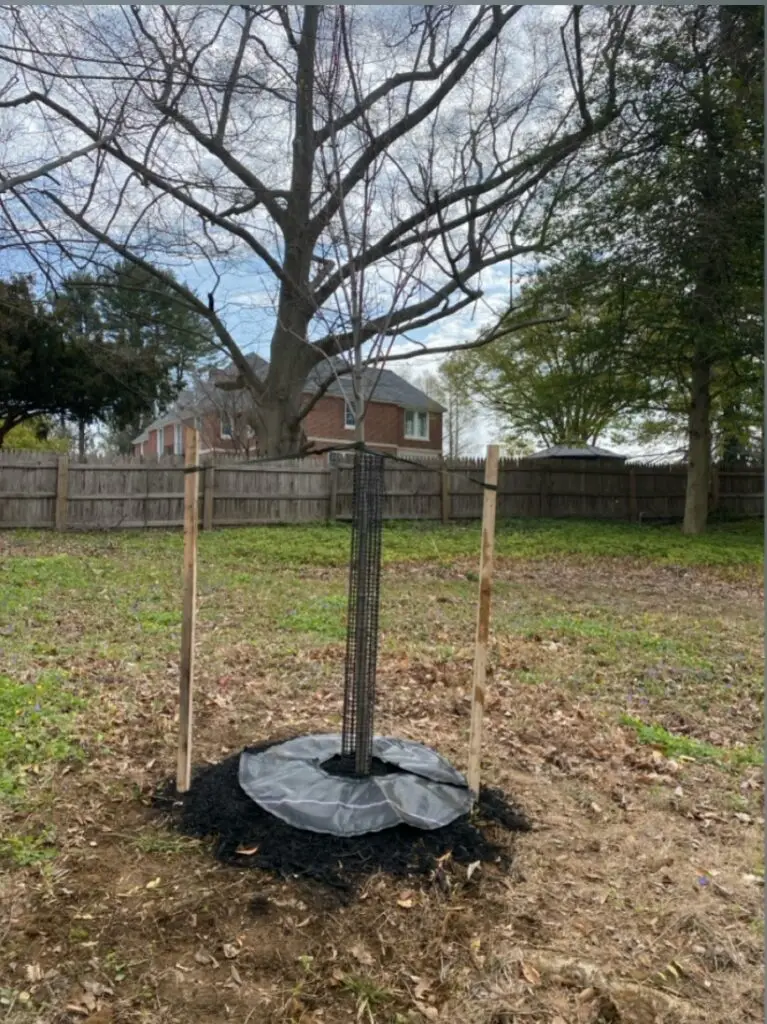
The Red Maple ‘Redpointe’ (Acer rubrum) is one of the more common replacement choices we see across Delaware County and the Main Line, and for good reason. At 40 to 50 feet it fits a typical suburban lot without overwhelming it, and the fall color is exceptional. It does drop seeds and leaves, so it is worth considering placement relative to a pool, a low-drainage area, or a heavily used patio. In the right spot it is a strong all-around canopy tree for this region.
The Quaking Aspen ‘Dancing Flame’ (Populus tremuloides), shown in the header photo, is a Pennsylvania native species that reaches 20 to 50 feet depending on site conditions. It offers distinctive foliage and a graceful movement in the wind that sets it apart visually. Aspens can send up root shoots around the base over time, which is worth knowing before placing one near a defined lawn edge or a garden bed you want to keep clean.
Why Placement Matters as Much as Species
The variety of species across these Radnor tree planting jobs reflects something the ISA emphasizes consistently: there is no single right answer for every property. The right tree depends on the function you need it to serve, the space available above and below ground, the soil conditions, the drainage, and what is already on the site.
In 15-plus years serving Delaware County, Montgomery County, and Chester County, our team has seen what happens when these factors are not accounted for at planting time. A fast-growing species planted too close to a foundation will find it eventually. A large canopy tree planted under overhead wires will need repeated pruning that stresses the tree over time. A species that prefers well-drained soil placed in a low spot will struggle from the start regardless of how well it was planted.
Getting this right at the time of planting is far less expensive than correcting it later. That is true whether you are replacing a tree we removed, filling a canopy gap, or adding shade and privacy to a part of your property that has always been exposed.
Spring Is the Right Time to Think About This
If we removed trees from your property last fall or this past winter, spring is when you will most notice the change. The canopy opens up, the light shifts, and the spots where your trees stood become obvious.
That is the best time to walk the property with someone who can assess those spots honestly — not just recommend what looks good in a catalog, but what will actually work for that specific location, that soil, and the function you need the tree to serve over the next twenty years.
Ready to talk about tree planting for your Delaware County property with an ISA Certified Arborist?
Schedule your free estimate today.
Executive Tree Care has served Delaware County, Montgomery County, and Chester County since 2009. ISA Certified Arborists Greg Drecher (#PD-2775A) and Doug Bull (#PD-0544A) provide tree risk assessment, removal, pruning, and planting services for residential and commercial properties. Fully licensed and insured.
For emergency service, call (484) 451-8900 — available 24 hours.