



Written by Greg Drecher, ISA Certified Arborist #PD-2775A, and Doug Bull, ISA Certified Arborist #PD-0544A | Executive Tree Care
If you are reading this after a storm has moved through Delaware County or the Main Line, the most important thing right now is to stay away from your trees until you know what you are dealing with. The cleanup impulse is natural. The assessment has to come first.
Wind events, tornado watches, and severe thunderstorms are a regular part of spring and summer in our area. These are the conditions that snap branches without warning, uproot shallow-rooted trees, and turn a perfectly healthy-looking tree into a liability overnight. We have been responding to calls like these for over 15 years across Delaware County and the Main Line. Here is what we tell homeowners every time.
How Storms Actually Damage Trees
Not all storm damage looks like damage. That is what makes it dangerous.
Strong winds break major branches and uproot trees outright, especially when saturated soil from heavy rain reduces the grip of the root system. What you often cannot see from the ground is the internal damage: trunk cracks that opened under wind load, root ball shifts that destabilized a tree without toppling it, and canopy breaks that left large limbs suspended — partially attached, held up by bark or other branches. Arborists call these widow makers. They are unpredictable when they finally let go, and they do not announce themselves first.
Lightning strikes create a different kind of problem. The heat from a strike vaporizes water inside the tree, which can rupture wood from the inside out. A tree struck by lightning may look intact for days or weeks before showing signs of structural failure.
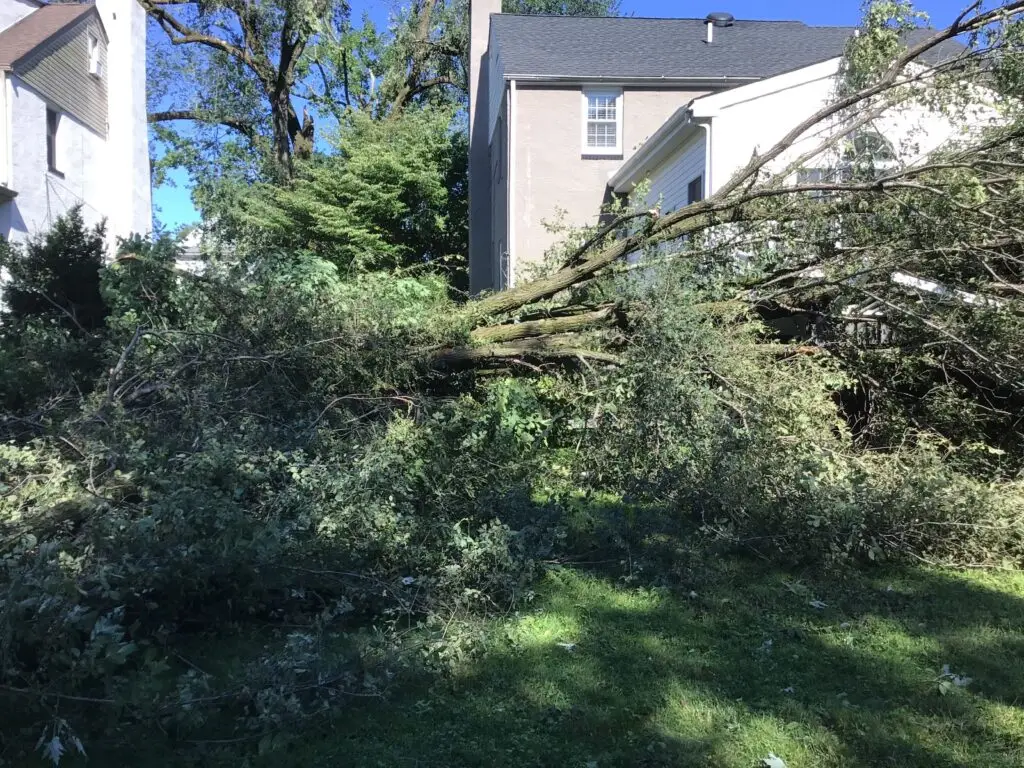
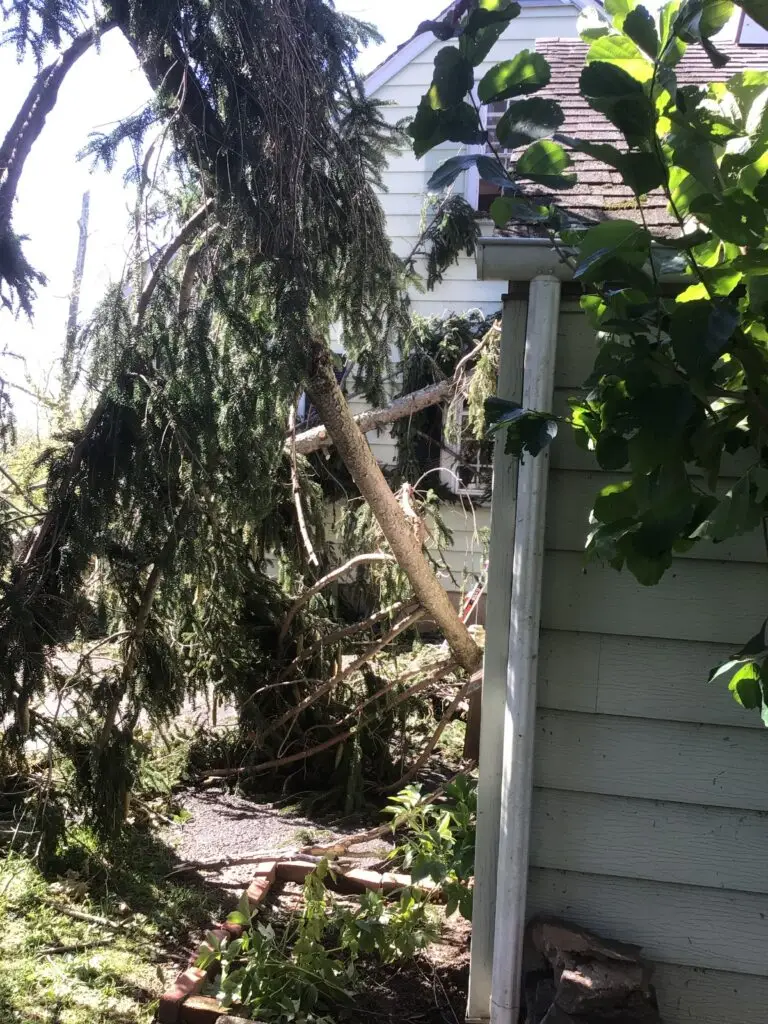
We have seen what these conditions produce firsthand. In Nether Providence Township right here in Delaware County, storm response calls brought our crews to properties where trees had come down on structures, blocked driveways, and left hanging limbs throughout the canopy. In September 2021, when Hurricane Ida moved through the region, our crews worked the Fort Washington area of Montgomery County for three weeks straight — trees down everywhere, on houses, across roads, pinning vehicles. What stands out from both responses is not just the volume of work, but how many of the most dangerous situations involved trees that homeowners had walked past that morning without realizing they were about to come down.
The Fort Washington response showed us what high wind events do regardless of species. An elm uprooted completely from the rear of a property, its root system unable to hold in saturated soil. A Norway Spruce came down into a house on the same street. Different trees, same storm, same result. Wind does not discriminate by species — it finds whatever structural weakness already exists and finishes the job. Norway Spruce in particular, which are common throughout Delaware County and Main Line properties, are vulnerable in high wind events due to their shallow root systems. When the soil is already saturated from rain ahead of a storm system, a mature spruce can uproot with very little warning.
What to Do Immediately After the Storm
1. Stay clear and treat everything as a hazard. Fallen limbs resting against other trees or structures are under tension. Broken branches near power lines should be treated as live until PECO confirms otherwise. Do not approach them. Do not attempt to move them.
2. Call your utility company if lines are involved. For most of Delaware County and the Main Line, that is PECO at 1-800-841-4141. This step comes before anything else.
3. Walk the perimeter from a safe distance and document what you see. Photographs taken before any cleanup begins matter for insurance purposes. Look for trees leaning toward structures, branches across the roofline or fence line, and any visible cracking or splitting at the trunk base.
4. Call an ISA Certified Arborist for an assessment — not just a cleanup crew. A cleanup crew removes what is already on the ground. An arborist evaluates the trees still standing and identifies which ones are now a risk that did not exist before the storm.
Why This Is Not a DIY Situation
We understand the impulse to handle it yourself. The storm passed, there is a branch on the lawn, and it looks manageable. Here is the reality from 15 years of post-storm work in this area:
Post-storm tree work is among the most dangerous residential tasks there is. Chainsaw injuries spike after major weather events because homeowners underestimate hanging limb tension, work at height without proper equipment, and operate near structures and utility lines without training. Professional arborists use rigging and techniques specifically designed for tension cuts — it is not the same job with a smaller saw.
What a Professional Assessment Actually Covers
When one of our ISA Certified Arborists responds to a storm damage call in Nether Providence, Haverford, Wayne, Newtown Square, or anywhere across Delaware County and the Main Line, the assessment goes beyond what visibly broke.
The trees still standing are often where the real problem is. We check for:
- Trunk and major limb cracks that opened under wind load
- Root zone disturbance, including soil heaving at the base of the tree
- Canopy asymmetry from broken limbs that shifted the weight distribution
- Hanging or partially attached branches anywhere in the crown
- Structural weaknesses that the storm exposed but did not yet finish
If you are unsure whether a tree on your property was already showing warning signs before the storm, our arborists cover exactly what to look for in our guide to recognizing tree risk in Delaware County
Some trees can be saved with corrective pruning or crown restoration. Others cannot, and the honest answer is removal before the next storm finishes the job.
What You Can Do Before the Next Storm
Prevention does not guarantee a tree survives severe weather. But it changes the odds significantly.
Working with an ISA Certified Arborist before storm season allows you to identify branch and trunk defects early, remove dead or compromised wood, and correct structural problems — including damage from past improper pruning practices like topping, which is one of the most common reasons trees fail in high wind.
High-value trees near structures are also candidates for lightning protection systems. This is particularly relevant for large oaks and mature shade trees that are close to a home and would be costly to remove and replace.
In Delaware County and across the Main Line, the trees most frequently involved in storm damage calls are large oaks, silver maples, and Bradford pears — all common in residential neighborhoods and all with structural characteristics that put them at higher risk in high wind events.
The ISA’s TreesAreGood.org resource has additional guidance on storm preparation and finding a certified arborist in your area.
If Your Trees Were Damaged Today, Call Us
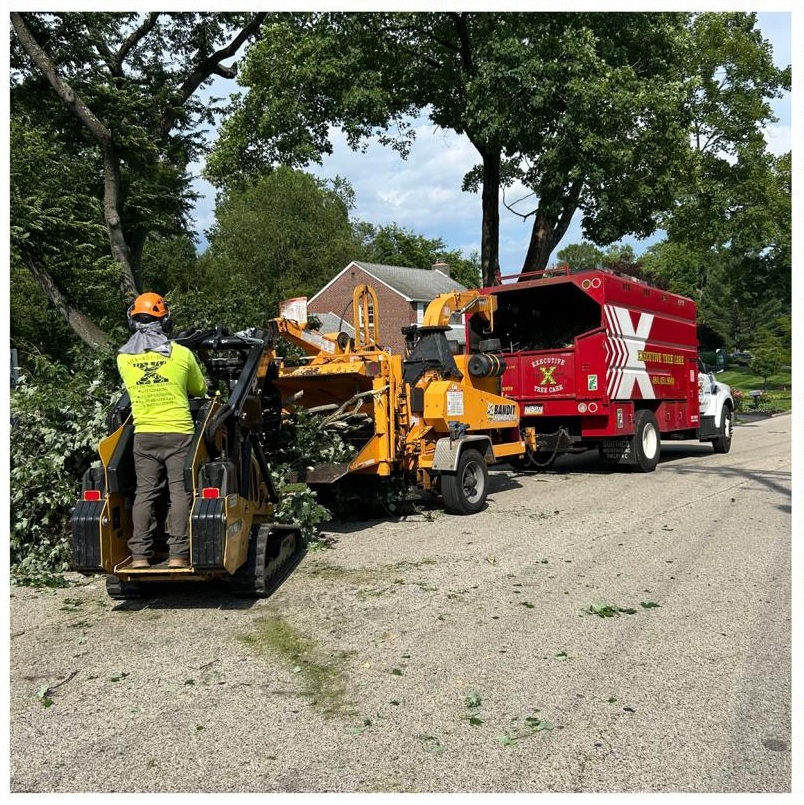
This is what a professional storm response looks like. Proper equipment, trained crew, ISA Certified Arborists directing the work.
Our ISA Certified Arborists serve Delaware County and the Main Line including Nether Providence, Haverford, Wayne, Bryn Mawr, Newtown Square, and surrounding communities. We will come out, assess what came down and what is still standing, and give you a straight answer about what needs to happen now and what can wait.